Colour families of painted cottage furniture
COLOUR
PLATE 01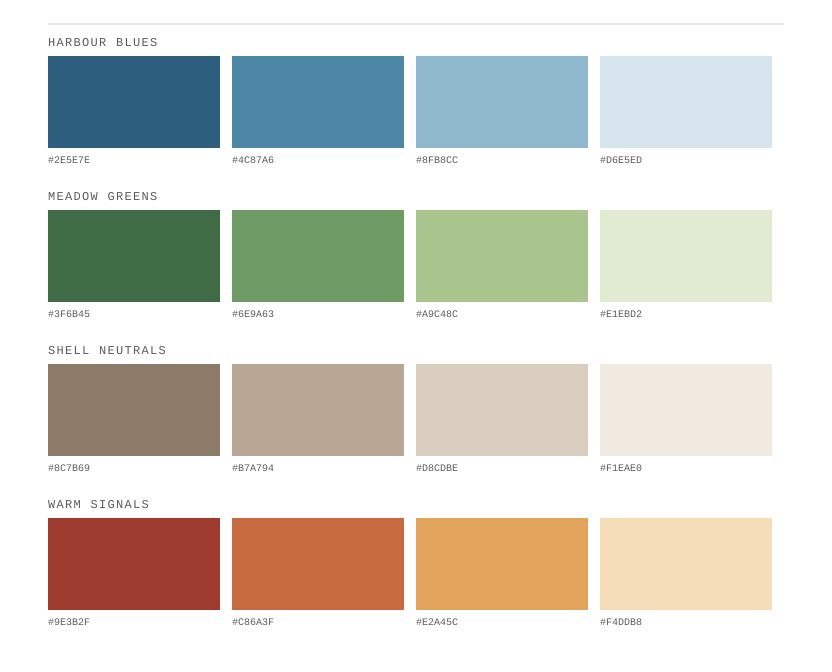
Sixteen flat colours grouped into four working families. Painted cottage furniture is usually chosen family by family rather than piece by piece, so a chest and a bed can sit in one room without competing.
Painted furniture is bought and lived with in families of colour rather than as single tones. A room that carries a painted bed, a painted chest and a pair of side tables is carrying three or four surfaces of flat colour at once, and those surfaces have to hold together across a whole wall. The plate above sets out sixteen colours in the four families that recur most often in cottage rooms.
Harbour blues
The blues run from a deep near-slate through to a pale wash that behaves almost like a neutral. They are the family most often used on large pieces, because a saturated blue on a bed end reads as a block of shadow rather than as a bright object, and the room keeps its calm. The pale end of the family is useful on interior surfaces: drawer boxes, the inside of a cupboard door, the underside of a shelf where a little colour is a surprise rather than a statement.
Meadow greens
Greens carry more of the outside into a room than blues do, and they sit unusually well beside bare wood floors. The mid greens are the workhorses. The deepest green in the family is best kept for small pieces and for painted rails, since a full chest in that tone will pull the eye to one corner of a room and hold it there.
Shell neutrals
The neutral family exists to give the other three somewhere to rest. These are the colours for the piece that has to be everywhere and noticed nowhere: the long chest under a window, the pair of bedside tables, the bench in a hallway. They are also the safest family for a first painted piece, because a neutral that turns out slightly wrong is a quiet mistake.
Warm signals
The warm family is deliberately short. One warm piece in a room does the work of three; two compete. A single warm chair or a warm-painted interior of an otherwise neutral cupboard is the usual limit. The deepest tone in this family is the accent used throughout this publication for plate numbers, which is a fair illustration of the role: small, repeated, and never the field.
Working across families
- Choose one family as the field and take no more than two colours from it for large pieces.
- Allow one piece from a second family, and keep it away from the room's main sight line.
- Keep the neutral family for anything long, low or repeated.
- Test a colour on the piece itself rather than on a card. A flat colour changes noticeably once it wraps a corner and catches light from two directions.
The families are a way of narrowing a decision, not a rule about taste. What matters is that the choice is made once, at the level of the family, rather than repeatedly at the level of the tin.